The transition towards a more sustainable aviation industry is no longer a future aspiration—it is a global priority. As governments, airlines, energy companies, investors, and technology providers work towards achieving net-zero emissions, Sustainable Aviation Fuel (SAF) has emerged as one of the most practical and scalable solutions for reducing aviation's environmental impact while using existing aircraft and infrastructure.
At the MEBAS (Middle East Business Alliance for Sustainability), our mission is to connect knowledge, industry, and innovation to support sustainable economic development across the region. Through our Market Sustainability Intelligence (#MEBASMSI) series, we aim to provide decision-makers with independent, research-driven insights that help organisations better understand emerging sustainability trends, market opportunities, and strategic challenges.
This report reflects months of research, international benchmarking, expert interviews, and industry analysis. It combines global best practices with regional perspectives, placing particular emphasis on the opportunities and challenges for the UAE as it builds its Sustainable Aviation Fuel ecosystem. Alongside market analysis, the report incorporates findings from the MEBAS Market Sustainability Intelligence Survey, offering valuable perspectives from professionals across the aviation, energy, sustainability, and investment sectors.
One of the strongest messages that emerged throughout this research is that the future of Sustainable Aviation Fuel is not determined by technology alone. Success will depend on collaboration across governments, industry, academia, financial institutions, and investors. Countries that create integrated ecosystems—supported by clear policies, investment, innovation, sustainable feedstocks, and international partnerships—will be best positioned to lead the aviation energy transition.
The UAE has demonstrated a clear commitment to sustainability, clean energy, and innovation. Its strategic location, world-class aviation infrastructure, growing renewable energy capacity, and ambitious national vision create significant opportunities to become a regional and global leader in Sustainable Aviation Fuel. While challenges remain, they are accompanied by equally significant opportunities for innovation, investment, and long-term economic growth.
We extend our sincere appreciation to all industry experts, organisations, partners, and survey participants who contributed their knowledge and perspectives to this report. Their insights have strengthened the analysis and enriched the recommendations presented throughout these pages.
We hope this Market Sustainability Intelligence Report serves as a valuable resource for policymakers, business leaders, investors, researchers, and all stakeholders working to shape the future of sustainable aviation. More importantly, we hope it encourages collaboration, informed decision-making, and practical action towards building a resilient, competitive, and sustainable aviation ecosystem for future generations.
Dagmar Turkova & Sandra Abramovic
I. Executive Summary
SAF is widely recognised as the most effective near- to medium-term solution for reducing aviation greenhouse gas (GHG) emissions while using the existing global aircraft fleet and airport infrastructure. Despite its importance, SAF currently accounts for well under 1% of global jet fuel consumption [16]. To align with global net-zero pathways, production will need to increase substantially by 2030.
The successful expansion of SAF will depend on the development of reliable supply chains, access to sustainable resources, competitive production costs, and supportive regulatory frameworks. As governments and industry stakeholders accelerate aviation decarbonization efforts, SAF presents significant opportunities for businesses involved in energy, aviation, infrastructure, logistics, technology, and investment.
Global policy developments are increasingly shaping the SAF market. The European Union has established ambitious SAF requirements through the ReFuelEU Aviation Regulation, creating a structured pathway for increased adoption through blending targets and sustainability standards. Under this regulation, EU airports must achieve a 70% share of SAF by 2050, a significant increase from the initial 2% requirement starting in 2025 [10]. These developments demonstrate the growing role of regulation in influencing future aviation fuel markets and investment decisions.
The United Arab Emirates is well positioned to become a regional center for SAF development. Through its General Policy for Sustainable Aviation Fuel, the UAE aims to support domestic SAF production, infrastructure development, and long-term aviation sustainability goals [27]. The country’s strategic advantages include its world-class aviation infrastructure, renewable energy potential, investment capacity, and position as a global aviation hub. However, challenges remain, including production costs, resource availability, and the development of commercially viable SAF supply chains.
This report examines the global and regional SAF landscape, with particular focus on opportunities and challenges for the UAE. It evaluates market developments, regulatory trends, infrastructure requirements, investment considerations, sustainability factors, and risks affecting the future growth of the SAF ecosystem.
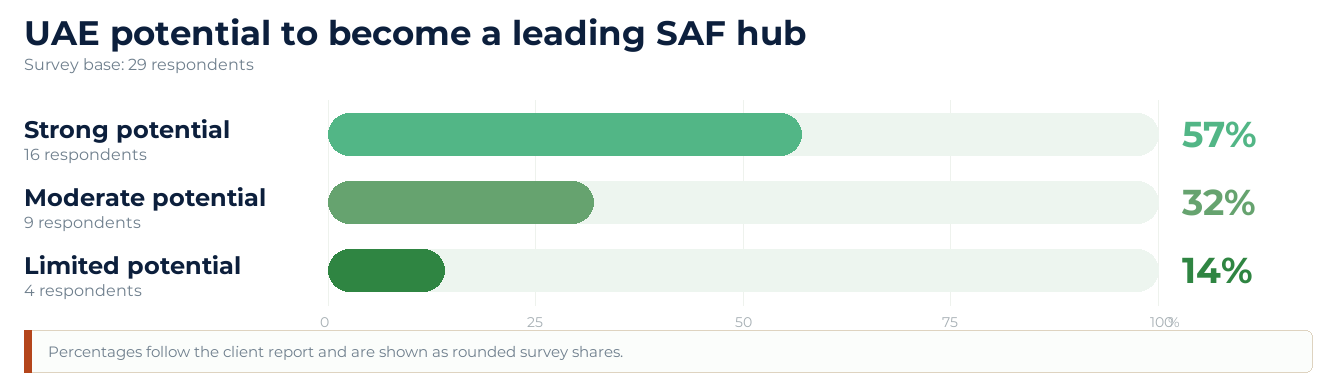
Graph: UAE Potential to Become a Global Sustainable Aviation Fuel (SAF) Hub
II. Sustainable Aviation Fuel (SAF) Definitions and Production Pathways
SAF is currently considered one of the most practical solutions for reducing aviation emissions while maintaining compatibility with existing aircraft, airports, and fuel infrastructure. Unlike alternative propulsion technologies such as hydrogen or battery-electric aircraft, SAF can be integrated into existing aviation systems with minimal operational changes. Depending on the production method and feedstock used, SAF can reduce lifecycle greenhouse gas emissions by typically around 80% compared with conventional jet fuel [12], with well-designed policy support seen as critical to achieving major lifecycle emissions reductions across all sustainable fuel pathways [17].
The development of SAF will require a combination of different production pathways rather than reliance on a single technology. Current market growth is expected to be driven primarily by commercially mature pathways, while emerging technologies are being developed to support long-term aviation decarbonization.
Current and Emerging SAF Pathways
HEFA/HVO (Hydroprocessed Esters and Fatty Acids)
HEFA is currently the most commercially established SAF pathway and uses waste oils, fats, and other lipid-based feedstocks. Its existing commercial availability makes it a key contributor to near-term SAF deployment. However, future expansion may be limited by the availability of suitable sustainable feedstocks.
Fischer-Tropsch (FT) Fuels
FT technology converts biomass, agricultural residues, and waste materials into synthetic fuels. While less commercially mature than HEFA, it provides opportunities to utilize a wider range of feedstocks, including waste streams that may be relevant for regions with limited agricultural resources.
Alcohol-to-Jet (ATJ)
ATJ converts renewable alcohol into aviation fuels and offers potential for using agricultural and waste-derived resources. Although commercial progress has been made, wider adoption depends on improving production capacity and cost competitiveness.
Power-to-Liquid (PtL/eSAF)
PtL represents a long-term pathway with significant potential, particularly for countries with strong renewable energy resources. By combining renewable electricity, hydrogen, and captured carbon dioxide, PtL can produce synthetic aviation fuels with potentially very low lifecycle emissions. However, current production costs remain high, and large-scale commercial deployment is still developing.
Other Pathways and Technologies
Additional approaches, including co-processing, catalytic hydrothermolysis, hydrogen-powered aircraft, and battery-electric aviation, continue to be explored. However, these technologies face varying levels of commercial readiness and are unlikely to replace liquid fuels for medium- and long-haul aviation in the near term.
For the UAE, PtL/eSAF represents a particularly strategic opportunity due to the country’s renewable energy potential, hydrogen ambitions, carbon capture capabilities, and existing energy infrastructure. However, successful deployment will depend on reducing costs, developing supply chains, and establishing partnerships across the aviation and energy sectors.
III. Lifecycle Emissions and Sustainability
One of the main reasons SAF is attracting global attention is its potential to significantly reduce lifecycle greenhouse gas (GHG) emissions compared with conventional jet fuel. However, experts contributing to this report consistently emphasised that not all SAF delivers the same environmental benefits. Actual emissions reductions depend on the feedstock used, the production pathway, the energy source, and how sustainability is managed across the entire value chain [11].
A consistent message from the expert discussions was that future competitiveness will be determined not only by the volume of SAF produced, but by the ability to demonstrate credible and verifiable sustainability performance. As regulations become more stringent and investors increasingly focus on environmental performance, transparent certification and robust lifecycle emissions accounting are expected to become key market differentiators.
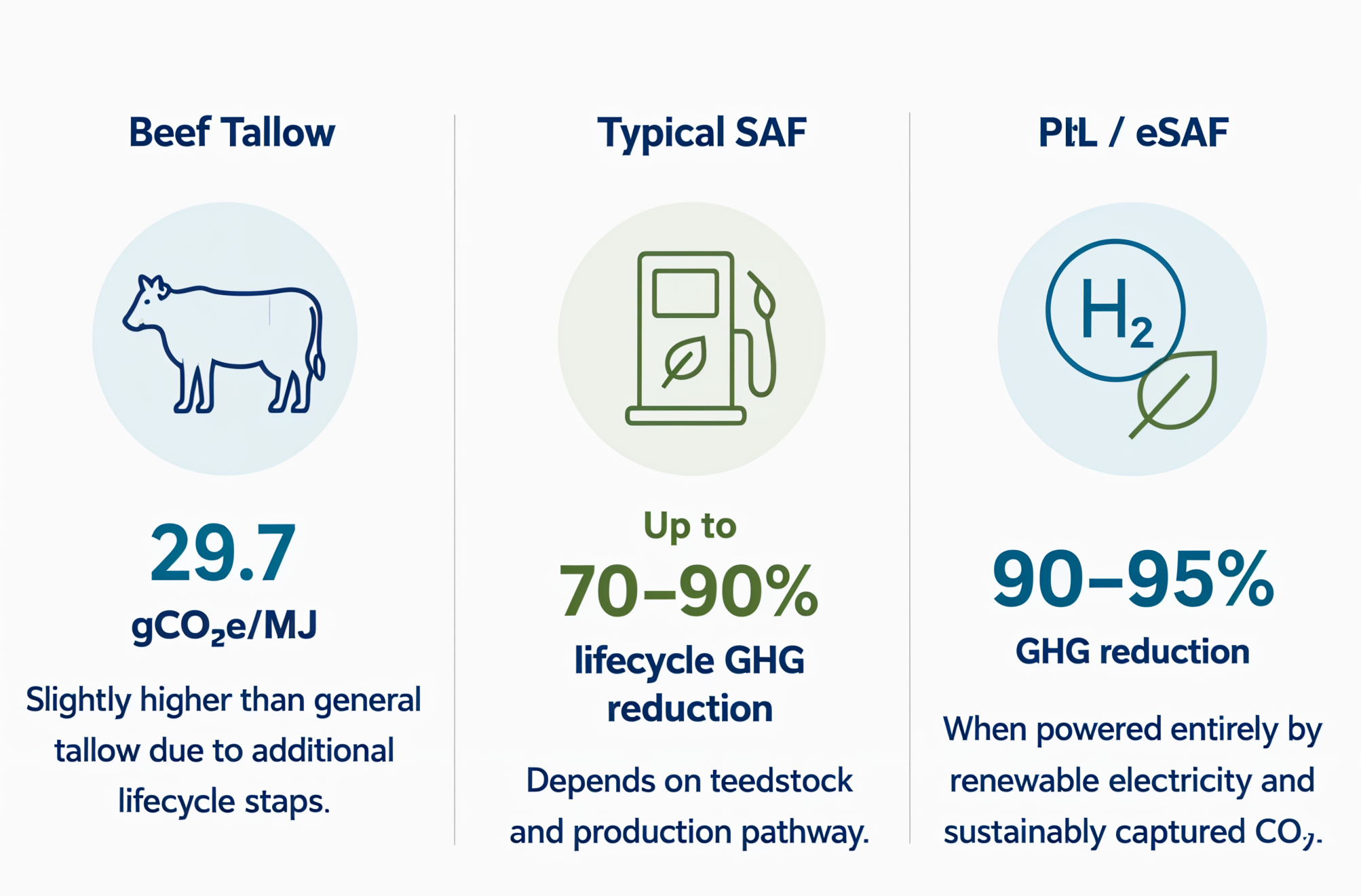
Most commercially available SAF pathways can achieve lifecycle greenhouse gas reductions of as high as 70% or over 90%, while advanced pathways such as Power-to-Liquid (PtL/e-SAF) have the potential to deliver even greater reductions of around 90-95% greenhouse gas emissions when powered by renewable electricity and supported by sustainably captured carbon dioxide [10][28].
Beyond carbon emissions, experts also highlighted the importance of sustainable feedstock sourcing. Long-term market growth will depend on feedstocks that minimise impacts on land use, biodiversity, freshwater resources, and food production while supporting circular economy principles. Waste oils, agricultural and forestry residues, municipal solid waste, renewable electricity, captured carbon dioxide, and other advanced feedstocks are widely viewed as offering the greatest long-term sustainability potential and are recognised under certification frameworks such as ICAO CORSIA and the European Union's Renewable Energy Directive [10][15].
Overall, the experts agreed that sustainability should be viewed as a strategic business consideration rather than simply a compliance requirement. Organisations that can demonstrate verified emissions reductions, responsible sourcing, and internationally recognised certification are likely to strengthen their competitive position as the global SAF market continues to evolve.
Typical Lifecycle Emissions by Feedstock and Pathway
Experts interviewed for this report agreed that future market competitiveness will increasingly depend not only on producing SAF at scale, but on demonstrating verified lifecycle carbon reductions, sustainable feedstock sourcing, and internationally recognised certification. As global regulations become more stringent, sustainability performance is expected to become a key differentiator for SAF producers, investors, airlines, and countries seeking to establish leadership in the emerging sustainable aviation fuel market.
IV. Feedstock Types and Availability
The availability of sustainable feedstocks remains one of the most important factors determining the future scale of SAF. While several production pathways have reached commercial maturity, experts contributing to this report consistently identified feedstock availability, long-term supply security, and commercial bankability as the principal constraints to accelerating global SAF production.
Several experts noted that future competitiveness will depend less on technology itself and more on securing sustainable feedstock supply chains capable of supporting long-term production. As SAF demand continues to increase globally, competition for high-quality feedstocks is expected to intensify, making feedstock diversification and circular resource utilisation increasingly important.
Proven low-carbon feedstock with established commercial production.
Limited global availability. FOG (fats, oils, and grease) comprises approximately 28% of the U.S.'s 23 million tonnes of annual domestic HEFA feedstock production. [24] Collection, traceability, and scaling remain challenging.
Municipal Solid Waste (MSW)
Large potential resource, particularly in the Middle East. Avoids additional land use and supports circular economy objectives. Masdar, ADNOC, bp, Tadweer (Abu Dhabi Waste Management Company) and Etihad Airways are studying MSW combined with green hydrogen for SAF production. [21] Several pilot projects are underway globally.
Requires advanced waste separation, processing, and cleaning infrastructure.
Agricultural Residues
Includes corn stover, sugarcane bagasse, rice husks, and palm fronds. Widely available globally and relatively low cost.
Collection logistics are complex, and excessive residue removal may reduce soil quality and carbon storage.
Dedicated Energy Crops
Includes camelina, carinata, sugarcane, sweet sorghum, and miscanthus. Some crops can be cultivated on marginal land or as cover crops. In the UAE, Salicornia, a salt-tolerant plant irrigated entirely with seawater, has moved beyond testing to real-world use: Etihad Airways flew its first biofuel-powered flight (Abu Dhabi–Amsterdam) in January 2019 using Salicornia-derived fuel, avoiding competition for fresh water or arable land [20].
Require land and, depending on crop selection, may compete with food production or water resources.
Algae
Microalgae and macroalgae could theoretically produce 7–31 times more oil per hectare than terrestrial crops [6] while utilising brackish or saline water, reducing competition for fresh water and arable land.
Commercial deployment remains limited due to high production costs.
Captured CO₂ + Green Hydrogen (Power-to-Liquid)
Eliminates dependence on biomass. Renewable hydrogen combined with captured CO₂ enables synthetic aviation fuel production. The UAE's abundant solar resources provide a significant long-term advantage. A World Economic Forum roadmap sets the target that PtL could supply up to 73% of UAE aviation fuel demand by 2050. [31]
High capital costs and significant renewable electricity requirements.
Biogas
Waste-derived biogas can be converted into aviation fuel via ATJ or Fischer-Tropsch pathways.
Early-stage technology with limited commercial deployment.
Table 3 Summarizes the feedstock opportunities and challenges.
Experts consistently identified the UAE as having a different competitive profile from many European markets. Rather than relying on large volumes of agricultural biomass, the country's strengths lie in its renewable energy resources, logistics capabilities, industrial infrastructure, and ability to develop advanced synthetic fuel pathways.
Key UAE feedstock opportunities include:
Urban and Industrial Waste: The UAE exceeds 21 million tonnes of MSW (municipal solid waste) annually [4]. Recycling rates continue to improve, creating opportunities for waste-to-SAF projects. The ongoing Masdar, ADNOC, bp, Tadweer (Abu Dhabi Waste Management Company) and Etihad Airways feasibility study exploring MSW and green hydrogen demonstrates the country's commitment to developing circular feedstock solutions [21].
Food Processing Waste and Animal Tallow: The UAE's food processing and livestock sectors generate animal fat by-products suitable for SAF production.
Halophytes and Algae: Khalifa University's SBRC programme has successfully tested halophytes, including Salicornia, together with algae-based feedstocks. These pathways are particularly relevant for arid climates because they minimise freshwater requirements [20].
Solar-to-Hydrogen Projects: The UAE continues to expand renewable energy capacity and green hydrogen production. DEWA's Green Hydrogen Project — the first solar-powered green hydrogen facility in the Middle East and North Africa — has produced around 90 tonnes of green hydrogen since its May 2021 launch, generating over 1 gigawatt-hour of clean electricity and reducing approximately 450 tonnes of CO2 emissions. The project is powered by the world's largest single-site solar park, which will reach over 5,000 MW of production capacity by 2030 — illustrating the UAE's abundant, low-cost solar energy as a long-term advantage for future green hydrogen and Power-to-Liquid SAF development [8].
Key Constraints
Despite these opportunities, several structural constraints remain. Limited arable land and freshwater resources mean the UAE cannot rely on conventional biomass at the same scale as many agricultural economies. As a result, future SAF production is expected to depend increasingly on waste streams, imported sustainable biomass, algae, wastewater-based feedstocks, and synthetic fuels produced from renewable electricity.
Expert Perspective
Experts contributing to this report consistently highlighted that feedstock availability-not technology-is likely to become the defining factor for future SAF competitiveness. While HEFA remains the dominant commercial pathway today, sustainable waste oils and animal fats are inherently limited and increasingly subject to global competition. Several experts therefore identified advanced pathways such as Power-to-Liquid (e-SAF) as the UAE's strongest long-term opportunity, supported by abundant solar resources, green hydrogen production, carbon capture capabilities, world-class logistics infrastructure, and significant investment capacity. At the same time, experts stressed that scaling SAF will require coordinated investment in regional feedstock supply chains, long-term offtake agreements, circular economy initiatives, and robust sustainability certification to ensure both environmental integrity and commercial viability.
V. Supply Chain, Infrastructure and Fuel Delivery
One of the strongest themes emerging from the expert interviews is that scaling SAF is not only a production challenge but an ecosystem challenge. While the technologies required to produce, store, transport, and distribute SAF are largely available, long-term success will depend on coordinated investment across the entire value chain and strong collaboration between governments, airlines, energy companies, infrastructure providers, investors, and regulators [14][17].
Experts consistently highlighted that resilient supply chains, long-term offtake agreements, supportive policy frameworks, and internationally recognised certification systems will be just as important as production capacity in accelerating commercial deployment. Building investor confidence and reducing project risk were identified as critical priorities for expanding the global SAF market.
Expert Perspective: The UAE Infrastructure Advantage
Experts and survey participants identified the UAE as one of the region's strongest candidates for developing a competitive SAF ecosystem. Its integrated energy sector, world-class airports, advanced refinery infrastructure, global logistics network, and growing renewable energy capacity provide a strong foundation for future SAF production, distribution, and export [31].
Beyond physical infrastructure, participants emphasised the UAE's ability to bring together government, industry, investors, and technology partners within a coordinated ecosystem. This collaborative approach is viewed as a significant competitive advantage that can accelerate commercial deployment, improve project bankability, and strengthen the country's position as a regional SAF hub.
Supply Chain and Infrastructure Requirements
Integrated SAF Supply Chain Flow
01
Feedstock Collection
Secure sustainable feedstock streams.
02
Production and Blending
Convert and blend SAF for certified use.
03
Storage and Certification
Maintain traceability, quality and compliance.
04
Airport Fuel Delivery
Move certified fuel into airport operations.
Scaling SAF depends on connecting physical infrastructure with traceability, certification and long-term demand.
Infrastructure Area
Current Status and Opportunities
Key Considerations
Biorefineries
New production facilities or retrofitted refineries are required to process sustainable feedstocks. Existing refineries, such as ADNOC's Ruwais Refinery, which has received International Sustainability Carbon Certification (ISCC) to co-process used cooking oil blended with jet fuel [1], demonstrate how existing sites can be adapted to produce SAF without building entirely new facilities. Other refineries could similarly co-process waste oils or install dedicated HEFA units. Commercial-scale PtL facilities will require large electrolyser capacity and carbon capture infrastructure.
Facility location is critical and should be close to feedstock sources, industrial clusters, ports, and transport infrastructure.
Transport and Logistics
Collecting distributed feedstocks such as used cooking oil, agricultural residues and municipal solid waste requires efficient logistics systems. The UAE benefits from world-class logistics infrastructure through Jebel Ali Port, Khalifa Port, and AD Ports, providing access to regional and international markets.
Reliable feedstock collection and transportation remain essential to achieving commercial-scale production.
Storage and Distribution
Existing jet fuel storage terminals and airport fuel farms can generally accommodate SAF. While SAF is compatible with existing storage infrastructure, dedicated segregation or certified mass-balance accounting systems are required to ensure traceability. Under ReFuelEU Aviation, airports must provide appropriate SAF storage infrastructure. [9] Dubai and Abu Dhabi airports have already announced plans to accommodate SAF hydrant systems. Blending is typically undertaken at pipeline terminals, airport fuel farms, or during tanker delivery.
Robust tracking and certification systems will become increasingly important as SAF volumes expand.
Aircraft Fuelling
Most certified SAF pathways are approved under ASTM D7566 as drop-in fuels requiring no aircraft or engine modifications. [26] Airlines can therefore use existing refuelling infrastructure. Testing has shown that aircraft can safely operate using very high SAF blends, although commercial operations currently use approved blend limits usually coming in around 50%.
As SAF adoption increases, accounting mechanisms such as mass balance and Book & Claim will play an increasingly important role [13][29] in allocating environmental attributes.
Table 4 Summarizes supply chain and infrastructure requirements.
Experts consistently emphasised that scaling SAF is not simply an infrastructure challenge-it is a coordination challenge. Long-term offtake agreements between airlines and producers, supportive government policies, investment in regional production facilities, transparent certification systems, and reliable logistics networks must develop together to create a commercially viable market. Several contributors also noted that future resilience will depend on diversified regional supply chains rather than reliance on global fuel imports. The UAE's combination of aviation demand, industrial infrastructure, renewable energy resources, sovereign investment capacity, and logistics connectivity places it in a strong position to become a regional SAF production, trading, and distribution hub.
SAF Scale-Up Coordination Model
01Long-term offtake
02Policy support
03Regional production
04Certification systems
05Reliable logistics
Commercially viable SAF market
VI. Costs and Scaling Timelines
One of the key messages emerging from the expert surveys is that the future of SAF will depend as much on commercial viability as on technological progress. While production technologies continue to mature, SAF remains significantly more expensive than conventional jet fuel requiring extensive capital expenditure, and thus creating one of the biggest barriers to large-scale market adoption [2].
Surveyed experts consistently highlighted that reducing the cost of SAF will require more than improvements in production technology. Long-term offtake agreements, supportive policy frameworks, investment certainty, and innovative financing mechanisms were identified as equally important for improving project bankability and attracting private capital. These views align with broader industry assessments, which emphasise the importance of coordinated public, private and philanthropic investment in accelerating SAF deployment [2].
Although production costs are expected to decline as technologies mature and production capacity expands, the pace of cost reduction will depend on continued policy support, feedstock availability, advances in renewable hydrogen, and economies of scale [17].
Expert Perspective: Financing the Transition
Several contributors noted that financing first-of-a-kind SAF projects remains challenging because production costs continue to exceed those of conventional aviation fuel. Experts emphasised that blended finance, public-private partnerships, sovereign investment, and long-term market certainty will be critical to reducing investment risk and accelerating commercial deployment.
For the UAE, participants highlighted that the combination of strong investment capacity, renewable energy resources, industrial infrastructure, and an integrated aviation ecosystem creates favourable conditions to support future SAF investment and commercialisation.
Indicative Cost Outlook
Timeframe
Market Outlook
Near term (to 2030)
Commercial production continues to expand, supported by policy incentives and long-term offtake agreements, although production costs remain significantly above conventional jet fuel.
Medium term (2030–2040)
Greater production capacity, technology improvements, and renewable hydrogen deployment are expected to improve competitiveness and reduce costs.
Long term (2040–2050)
Continued innovation, economies of scale, and supportive policy frameworks could significantly narrow the cost gap, although outcomes will depend on feedstock availability, energy prices, and carbon pricing mechanisms.
Contributors consistently agreed that reducing the cost of SAF will require more than technological progress. Long-term offtake agreements, supportive government policies, blended finance mechanisms, and stable regulatory frameworks will be equally important in improving project bankability and attracting investment. While production costs are expected to decline over time, coordinated action across governments, airlines, fuel producers, investors, and financial institutions will be essential to achieving commercial scale.
VII. Policy Instruments, Mandates and Incentives
Policy frameworks emerged as one of the strongest themes during the expert surveys. While technology continues to advance, contributors consistently agreed that long-term policy certainty, investment incentives, and coordinated regulation will determine the pace of SAF deployment.
Further, experts emphasised that successful SAF markets require more than production capacity. Blending mandates, financial incentives, sustainability certification, carbon pricing, and long-term demand signals all play an important role in reducing investment risk and improving project bankability. Around the world, governments are adopting different combinations of these measures to accelerate SAF production and encourage market adoption, such as the EU with their ReFuelEU initiatives and goals.
Global Policy Landscape
Region / Country
Key Policy Approach
Current Direction
European Union
ReFuelEU Aviation blending mandates and sustainability requirements [11]
Mandatory SAF blending targets increasing from 2025 to 2050, including dedicated targets for synthetic aviation fuels.
United States
Production tax credits and financial incentives
Inflation Reduction Act supports SAF production through tax credits linked to lifecycle emissions reductions. [30]
United Kingdom
Jet Zero Strategy
As of January 2025, the Jet Zero Strategy mandate has come into effect. [22][7] This means that 2% of the UK’s total jet fuel demand has to be met with SAF.
Canada
Clean Fuel Regulations
Incentives supporting lower-carbon fuels, including SAF. [5]
Japan
Green Growth Strategy
National targets combined with research, innovation, and industry partnerships. [3]
United Arab Emirates
General Policy for Sustainable Aviation Fuel
National strategy supporting domestic SAF production, infrastructure, and international certification. [27]
Table 6 Summaries the Global Policy Landscape surrounding SAF of the EU, US, UK, Canada, Japan and UAE.
Contributors highlighted that policy consistency is just as important as financial support. Clear regulatory frameworks, internationally recognised certification standards, and long-term offtake agreements provide the confidence needed for industry and investors to commit to large-scale SAF projects. Several experts also identified Book & Claim systems as an important mechanism for increasing market flexibility while supporting demand in regions where physical SAF supply remains.
Expert Perspective: The UAE Policy Outlook
Surveyed experts recognised that the UAE has taken important steps through its General Policy for Sustainable Aviation Fuel, supporting production targets, infrastructure development, international sustainability certification, and collaboration across government and industry. Participants noted that continued policy development, combined with the country's strong investment capacity and integrated aviation ecosystem, could position the UAE as a regional hub for SAF production, certification, and trade.
MEBAS Survey Insight
The latest MEBAS Market Sustainability Intelligence (MSI) Survey identifies government incentives and regulation as the most influential factor in enabling the UAE to become a leading Sustainable Aviation Fuel (SAF) hub, accounting for 35% of all responses. Respondents consistently highlighted the importance of establishing clear regulatory frameworks, long-term policy certainty, and targeted financial incentives to encourage investment, reduce commercial risk, and accelerate the development of a competitive domestic SAF market.
Survey participants also emphasised that policy measures should be complemented by investment in production infrastructure, long-term SAF blending mandates, secure offtake agreements, and stronger collaboration between government, airlines, energy companies, investors, and technology providers. Together, these actions are viewed as essential to creating the market confidence needed to scale SAF production and attract long-term private sector investment.
Key Insight:
Industry stakeholders believe that sustained government leadership, supported by clear regulation, long-term policy certainty, and strategic investment, will be the most important catalyst for accelerating commercial-scale SAF production and positioning the UAE as a regional and global leader in sustainable aviation.
Policy Enablement Pathway
Clear regulatory frameworkStable rules and long-term market confidence.
Targeted financial incentivesReduce the green premium and investment risk.
Long-term offtake confidenceSupport bankability through committed demand.
Cross-industry collaborationAlign government, aviation, energy and investors.
Policy certainty, investment support, demand signals, and collaboration create the confidence needed to scale SAF production.
Expert Perspective
Experts contributing to this report consistently agreed that scaling Sustainable Aviation Fuel is no longer primarily a technology challenge but an ecosystem challenge. While commercially viable production pathways already exist, large-scale deployment will depend on coordinated action across governments, airlines, fuel producers, investors, financial institutions, and technology providers.
Several contributors highlighted that long-term policy certainty, investment in advanced production technologies such as Power-to-Liquid (e-SAF), secure feedstock supply, long-term offtake agreements, robust certification systems, and transparent Book & Claim mechanisms will be essential to reduce investment risk and improve project bankability. Experts also identified the UAE's unique combination of world-class aviation infrastructure, renewable energy potential, sovereign investment capacity, and strong government commitment as providing a significant competitive advantage to become a leading regional and global SAF hub.
VIII. Book & Claim and Certification Schemes
As SAF markets continue to grow, surveyed experts consistently highlighted that trusted certification and transparent accounting systems will be critical for building market confidence, supporting international trade, and demonstrating verified emissions reductions.
One topic frequently raised during the expert surveys was the growing importance of Book & Claim. Contributors viewed it as a practical mechanism for expanding SAF adoption by allowing organisations to purchase the environmental attributes of certified SAF, even when physical fuel is not available at their operating location. As global SAF production increases, Book & Claim is expected to improve market accessibility, encourage investment, and support the development of more flexible international supply chains.
Expert Perspective: Certification and the UAE Opportunity
Experts agreed that internationally recognised certification will be essential for ensuring market credibility and enabling access to global SAF markets. They highlighted the importance of aligning with recognised frameworks such as ICAO CORSIA, ISCC, and the EU Renewable Energy Directive (RED II/III) to demonstrate sustainability performance and facilitate international trade.
Several contributors also identified an opportunity for the UAE to position itself as a regional centre for SAF certification, trading, and Book & Claim services. Leveraging its aviation connectivity, digital infrastructure, and international partnerships could strengthen the country's role in the emerging global SAF market while supporting wider regional adoption.
Certification Frameworks
Framework
Purpose
ICAO CORSIA
Establishes sustainability and lifecycle emissions requirements for internationally recognised SAF. [15]
ISCC CORSIA
ICAO-approved certification scheme for CORSIA Eligible Fuels. [18]
Roundtable on Sustainable Biomaterials (RSB)
International sustainability certification covering environmental and social criteria. [25]
ISCC EU / RED II & RED III
Demonstrates compliance with the EU Renewable Energy Directive sustainability requirements. [19]
REDcert
EU-recognised certification system for sustainable fuels and biomass. [23]
Table 7 summaries the Certification Frameworks in place.
Experts interviewed for this report consistently identified Book & Claim as one of the most practical mechanisms for accelerating SAF market development during the industry's early growth phase. While physical SAF availability will remain limited in many regions over the coming decade, Book & Claim can broaden market participation by enabling airlines and corporate customers to purchase verified sustainability attributes regardless of fuel location.
Contributors also emphasised that successful implementation would depend on transparent digital registries, internationally recognised certification, independent verification, and robust governance to maintain market confidence and prevent double counting. Several experts further noted that the UAE has the opportunity to position itself not only as a producer of Sustainable Aviation Fuel, but also as a regional centre for SAF certification, digital registry services, certificate trading, and sustainability verification, strengthening its role within the global sustainable aviation ecosystem.
IX. Financing Models
Financing emerged as one of the most important themes during the expert interviews. Contributors consistently agreed that scaling SAF will require more than capital investment—it will depend on creating commercially viable projects supported by long-term demand, stable policy frameworks, secure feedstock supply, and effective risk-sharing mechanisms.
Experts emphasised that no single financing model will be sufficient. Instead, successful SAF projects are expected to combine private investment with public support through blended finance, public-private partnerships, long-term offtake agreements, and green finance instruments. These approaches can improve project bankability, reduce investment risk, and accelerate commercial deployment.
Expert Perspective: Investment Outlook
Participants highlighted that investor confidence will depend on predictable policy, reliable certification, and long-term market certainty as much as technological progress. They also recognised that the UAE's strong investment capacity, integrated energy sector, and growing sustainability agenda provide favourable conditions to attract SAF investment and support the development of a regional production ecosystem.
Common Financing Models for SAF
Financing Model
Strategic Role
Equity & Project Finance
Supports the development of commercial-scale SAF production facilities.
Green Bonds & Sustainability-Linked Finance
Provides access to capital for eligible low-carbon and transition projects.
Public-Private Partnerships (PPPs)
Shares investment risk and supports early-stage commercial deployment.
Carbon Markets
Creates additional financial incentives through recognised emissions reduction mechanisms.
Innovation Funding
Supports research, demonstration projects, and technology commercialisation.
Table 8 Summaries the Common Financing models for SAF.
Key Investment Challenges
Challenge
Potential Response
High capital requirements
Blended finance and public-private partnerships
Higher production costs
Policy support, incentives, and technology improvements
Limited long-term revenue certainty
Long-term offtake agreements
Technology and investment risk
Demonstration projects and strategic partnerships
Feedstock availability
Diversified supply chains and long-term sourcing strategies
Table 9 Summaries the key investment challenges.
MEBAS Survey Insight
The latest MEBAS Market Sustainability Intelligence (MSI) Survey demonstrates an overwhelming industry consensus on the importance of cross-sector collaboration in accelerating SAF deployment. More than 70% of respondents rated cross-industry partnerships as critical, while the remaining respondents considered them very important.
Survey Finding
Result
Cross-industry partnerships rated Critical
71%
Cross-industry partnerships rated Very Important
29%
Table 10 Summaries the statistical results from the MEBAS MSI detailing importance of Cross-Industry partnerships.
The survey findings indicate that stakeholders view collaboration as one of the most important enablers of commercial-scale SAF deployment. Respondents emphasised that strong public-private partnerships, international cooperation, and coordinated action across the aviation value chain are essential to reducing investment risk, mobilising capital, accelerating technology development, strengthening supply chains, and creating the policy certainty required for long-term market growth.
Key Insight: Industry stakeholders overwhelmingly agree that effective collaboration between the public and private sectors will be fundamental to accelerating SAF adoption, attracting investment, and building a resilient and globally competitive sustainable aviation ecosystem.
Expert Perspective
Experts interviewed for this report consistently agreed that the principal challenge is not the availability of capital but the bankability of SAF projects. While investor interest continues to grow, many first-of-a-kind facilities remain difficult to finance because production costs remain significantly higher than conventional jet fuel and long-term revenue certainty is still limited.
Several contributors highlighted that successful financing will depend on a combination of long-term airline offtake agreements, supportive government policies, blended finance structures, sovereign investment, green bonds, and innovative financing mechanisms that reduce the green premium and improve project bankability. Experts also noted that the UAE's unique combination of sovereign capital, renewable energy resources, integrated aviation ecosystem, and strategic partnerships provides a strong foundation for attracting international investment and accelerating commercial SAF deployment.
X. Risk Management and Transition
The transition to SAF presents significant opportunities but also introduces commercial, operational, and regulatory risks that will influence the pace of market development. Industry assessments consistently identify feedstock availability, production costs, policy certainty, and investment risk as some of the main challenges to scaling SAF globally. Moreover, the risk of integration, especially as SAF currently represents less than 1% of global aviation fuel [12].
Experts contributing to this report agreed that resilience should be built into the SAF ecosystem from the outset. Rather than relying on a single technology or feedstock, successful markets will require diversified supply chains, flexible production pathways, stable policy frameworks, and long-term collaboration across governments, industry, and investors.
Expert Perspective: Building a Resilient Ecosystem
Participants highlighted that reducing risk is essential to attracting long-term investment. Diversifying feedstocks, strengthening supply chains, and providing clear and predictable policy frameworks were identified as key priorities for improving market confidence and supporting commercial deployment.
For the UAE, experts noted that its integrated energy sector, strong logistics infrastructure, and investment capacity provide a solid foundation for developing a resilient SAF ecosystem. At the same time, continued investment in renewable energy, advanced feedstocks, and international partnerships will be important to strengthen long-term competitiveness.
Key Risks and Mitigation Approaches
Key Risk
Mitigation Approach
Feedstock availability
Diversify sustainable feedstocks and strengthen regional supply chains.
Production costs
Improve commercial viability through supportive policies, innovation, and economies of scale.
Policy and regulatory uncertainty
Provide stable, long-term regulatory frameworks aligned with international standards.
Investment risk
Encourage blended finance, public-private partnerships, and long-term offtake agreements.
Table 11 summaries the key risks and mitigation approaches to integrating SAF into the aviation industry.
Expert Perspective: The UAE
Experts noted that the UAE's integrated energy sector, advanced logistics infrastructure, and growing investment in renewable energy provide a strong foundation for supporting the development of a resilient SAF ecosystem. At the same time, participants recognised that limited domestic biomass resources reinforce the importance of diversifying feedstocks, investing in advanced production pathways, and strengthening international partnerships to support long-term market resilience.
Key Takeaway
Across the expert interviews, there was broad agreement that the long-term success of SAF will depend on building resilient ecosystems rather than focusing on individual technologies. Diversified feedstocks, stable policy frameworks, reliable supply chains, and collaboration between governments, industry, and investors were consistently identified as the foundations for sustainable market growth.
SAF Risk Resilience Priorities
01Diversified feedstocks
02Stable policy frameworks
03Reliable supply chains
04Investor collaboration
XI. EU Benchmarks and Global Best Practices
Experts contributing to this report consistently highlighted that successful SAF markets are built on more than technology. Long-term policy certainty, coordinated regulation, investment, industry collaboration, and innovation were identified as the key factors supporting market development.
The European Union is widely recognised as one of the leading examples of a coordinated SAF market through initiatives such as ReFuelEU Aviation, which combines blending mandates with sustainability requirements and long-term policy signals to encourage investment [9]. Similar approaches are emerging in other regions through financial incentives, public-private partnerships, and support for research and innovation.
Global Best Practice Benchmarks
Best Practice
Global Example
Opportunity for the UAE
Long-term policy certainty
ReFuelEU Aviation provides long-term blending targets and sustainability requirements.
Continue building a predictable policy framework that supports long-term investment.
Coordinated ecosystem
Collaboration between governments, airlines, fuel producers, airports, and investors supports SAF deployment.
Strengthen collaboration across the UAE's integrated aviation and energy sectors.
Investment support
Public funding and financial incentives reduce investment risk and encourage commercial deployment.
Continue attracting public and private investment into SAF production and infrastructure.
Innovation and research
International programmes support demonstration projects and technology development.
Expand partnerships between industry, research institutions, and technology providers.
Table 12 summaries the key risks and mitigation approaches to integrating SAF into the aviation industry.
Experts noted that while the UAE is at an earlier stage of SAF market development than Europe, it also has the opportunity to build an integrated ecosystem from the outset. Participants highlighted the country's strong aviation sector, energy infrastructure, investment capacity, and renewable energy ambitions as important foundations for future growth. Rather than replicating other markets, experts suggested that the UAE can build on international best practices while developing an approach that reflects its own resources, priorities, and regional role.
Overall, contributors agreed that long-term success will depend on continued collaboration between government, industry, investors, and research institutions, supported by clear policy direction and sustained investment.
XII. SWOT Analysis: The UAE as a Sustainable Aviation Fuel (SAF) Hub
The expert interviews, MEBAS MSI Survey, and international market review indicate that the UAE has many of the strengths needed to support the development of a competitive SAF ecosystem. At the same time, participants highlighted that long-term success would depend on continued investment, diversified feedstocks, supportive policies, and strong international collaboration.
The SWOT analysis summarises the key themes identified throughout this report.
Strengths
Weaknesses
• Integrated aviation, energy, logistics, and industrial ecosystem provides a strong foundation for SAF development.
• Limited domestic biomass resources, including freshwater and arable land, constrain conventional feedstock availability.
• Strong government commitment demonstrated through the UAE General Policy for Sustainable Aviation Fuel and long-term sustainability ambitions.
• Commercial-scale SAF production is still at an early stage, with most projects focused on feasibility, demonstration, or early deployment.
• Abundant renewable energy resources create long-term opportunities for green hydrogen and Power-to-Liquid (PtL/e-SAF) production.
• Higher production costs compared with conventional jet fuel continue to affect commercial competitiveness and project bankability.
Opportunities
Threats
• Growing global demand for SAF driven by international climate commitments, airline decarbonisation strategies, and regulatory frameworks.
• Global competition for sustainable feedstocks and investment may constrain future production capacity.
• Expansion of renewable energy and green hydrogen creates opportunities for advanced SAF pathways, particularly PtL/e-SAF.
• Delays in policy implementation or changes in international regulations could affect investment confidence and market growth.
• International partnerships, innovation, and technology transfer can accelerate commercial deployment and strengthen regional competitiveness.
• Continued cost differences between SAF and conventional jet fuel may slow market adoption without supportive policy measures.
• Development of regional certification, Book & Claim mechanisms, and SAF trading could strengthen the UAE's role in international aviation markets.
• Supply chain disruptions or slower-than-expected technology deployment could delay commercial scaling.
• Experts identified the UAE's investment capacity and integrated ecosystem as strong foundations for attracting international SAF projects and supporting regional market leadership.
• Experts emphasised that maintaining long-term competitiveness will require continued innovation, collaboration, and investment as global SAF markets evolve.
Table 13 summaries the key risks and mitigation approaches to integrating SAF into the aviation industry.
Across the expert interviews and the MEBAS MSI Survey, one message emerged consistently: developing a successful SAF market requires more than increasing fuel production. Contributors highlighted the importance of long-term policy certainty, diversified feedstocks, public-private collaboration, internationally recognised certification, investment, and coordinated action across the aviation value chain. Together, these elements form the foundation of a resilient and competitive SAF ecosystem.
XIII. Roadmap and Recommendations
The expert interviews, MEBAS MSI Survey, and international market review indicate that the UAE has many of the foundations required to support the development of a competitive SAF ecosystem. Contributors consistently emphasised that long-term success would depend on coordinated action across government, industry, investors, research institutions, and the aviation sector.
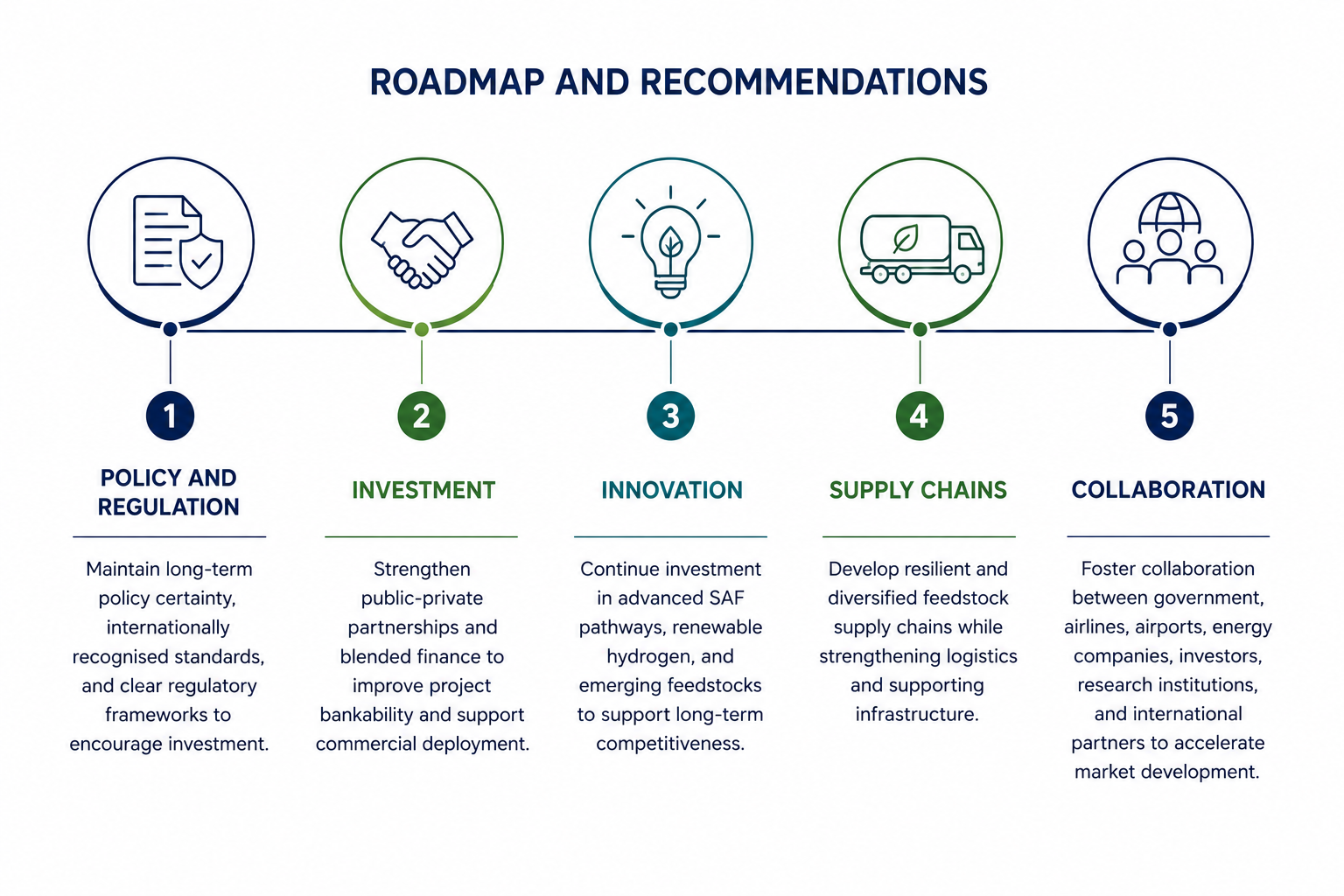
Rather than identifying a single pathway, experts highlighted several strategic priorities that can support future market development.
Strategic Priorities
Priority Area
Expert Perspective
Policy and Regulation
Maintain long-term policy certainty, internationally recognised sustainability standards, and clear regulatory frameworks to encourage investment.
Investment
Strengthen public-private partnerships and blended finance to improve project bankability and support commercial deployment.
Innovation
Continue investment in advanced SAF pathways, renewable hydrogen, and emerging feedstocks to support long-term competitiveness.
Supply Chains
Develop resilient and diversified feedstock supply chains while strengthening logistics and supporting infrastructure.
Collaboration
Foster collaboration between government, airlines, airports, energy companies, investors, research institutions, and international partners to accelerate market development.
Table 14 summaries the strategic priorities and the experts perspective.
MEBAS Survey Insight
The MEBAS MSI Survey indicates that industry stakeholders view SAF as a significant strategic opportunity while recognising that large-scale deployment will depend on a stable regulatory environment, supportive policies, investment certainty, and collaboration across the aviation value chain.
These findings closely align with the expert interviews and international market trends presented throughout this report.
Concluding Perspective
This MSI Report highlights that SAF is emerging as an important component of the aviation sector's transition towards lower-carbon operations. Across the expert interviews, MEBAS MSI Survey, and international benchmarking, contributors consistently identified policy certainty, sustainable feedstocks, investment, innovation, internationally recognised certification, and collaboration as the key foundations for long-term market development.
For the UAE, experts recognised significant opportunities to build on its integrated aviation and energy sectors, renewable energy ambitions, strategic location, and investment capacity. Rather than replicating existing models, participants suggested that the UAE can draw on international experience while developing an approach that reflects its own strengths and regional priorities.
Ultimately, the report concludes that developing a competitive SAF ecosystem will require continued collaboration between government, industry, investors, and research institutions, supported by long-term policy certainty and sustained investment. These themes were consistently reflected in both the expert interviews and the MEBAS Market Sustainability Intelligence Survey and provide a foundation for future dialogue as the global SAF market continues to evolve.
SAF Investment Attractiveness Outlook
35%Moderately Attractive
29%High Risk / Uncertain
24%Highly Attractive
12%Neutral
Expert responses show opportunity, but also reinforce the need for policy certainty, bankability and coordinated market execution.
XIV. Strategic Priorities for the UAE
The expert interviews, MEBAS MSI Survey, and international market review indicate that the UAE has many of the foundations required to support the development of a competitive SAF ecosystem. Contributors consistently emphasised that long-term success would depend on coordinated action across government, industry, investors, research institutions, and the aviation sector.
Boardroom and Expert Insights
Across the expert interviews, several common themes emerged regardless of industry background:
SAF should be viewed as an integrated ecosystem rather than a standalone fuel. Experts consistently highlighted that long-term success would depend on aligning policy, investment, infrastructure, feedstock development, certification, and market demand rather than focusing on a single production pathway.
Policy certainty was identified as one of the strongest enablers of investment. Contributors emphasised that stable regulatory frameworks, internationally recognised sustainability standards, and long-term market signals are essential to improve project bankability and attract private capital.
Collaboration across the value chain was viewed as essential. Experts highlighted the importance of long-term partnerships between governments, airlines, airports, energy companies, investors, and research institutions to accelerate commercial deployment and reduce investment risk.
Future competitiveness will depend on resilience rather than speed. Contributors stressed the importance of diversified feedstocks, secure supply chains, phased investment, and commercially viable financing models to support long-term market growth.
For the UAE, experts consistently identified advanced fuels as a long-term opportunity. Rather than competing through conventional biomass, participants highlighted renewable energy, green hydrogen, carbon management, logistics capabilities, and international connectivity as strategic advantages that could support future Power-to-Liquid (PtL/e-SAF) development and strengthen the UAE's role in regional SAF markets.
Strategic Priorities
Priority Area
Expert Perspective
Policy and Regulation
Maintain long-term policy certainty and internationally recognised sustainability standards to encourage investment.
Investment
Strengthen blended finance, public-private partnerships, and long-term offtake agreements to improve project bankability.
Innovation
Continue investment in advanced SAF pathways, renewable hydrogen, and emerging feedstocks to support long-term competitiveness.
Supply Chains
Develop resilient and diversified feedstock supply chains supported by infrastructure and international partnerships.
Collaboration
Strengthen collaboration between government, industry, investors, and research institutions to accelerate SAF market development.
Table 15 summaries the strategic priorities and the experts perspective.
XV. Conclusions and Strategic Outlook
The transition towards SAF represents an important opportunity to support the aviation sector's decarbonisation while strengthening energy resilience, industrial development, and international collaboration. As governments, airlines, energy companies, investors, and technology providers accelerate efforts to reduce aviation emissions, SAF is expected to play an increasingly important role in the future aviation energy mix.
This MSI Report combines international benchmarking, expert interviews, and the findings of the MEBAS MSI Survey to assess the opportunities and challenges shaping the future of SAF. Together, these perspectives indicate that the UAE has many of the foundations needed to support the development of a competitive and internationally connected SAF ecosystem, including an integrated aviation and energy sector, advanced infrastructure, growing renewable energy capacity, and a supportive policy environment.
The MEBAS MSI Survey reinforces this outlook. A majority of respondents (57%) believe the UAE has strong potential to become a leading SAF hub, while a further 32% see moderate potential. Respondents identified government leadership, infrastructure development, strategic partnerships, and innovation as the principal enablers of future market growth. At the same time, regulatory uncertainty, feedstock availability, long-term demand, and production costs were identified as the main barriers to scaling SAF.
The expert interviews further strengthened these findings. Across sectors, contributors consistently emphasised that the future of SAF is not solely a technology challenge but an ecosystem challenge. Long-term success will depend on policy certainty, diversified feedstocks, resilient supply chains, investment in advanced production pathways, internationally recognised certification, and collaboration between governments, industry, investors, research institutions, and technology providers.
International benchmarking presented throughout this report demonstrates that the most advanced SAF markets combine clear policy frameworks, sustained investment, innovation, and collaboration across the aviation value chain. These same priorities emerged consistently from both the expert interviews and the MEBAS MSI Survey, providing a strong foundation for the continued development of the UAE's SAF ecosystem.
Rather than identifying a single pathway to success, this report highlights the importance of building an integrated ecosystem that combines policy, investment, innovation, resilient supply chains, and cross-sector collaboration. As global SAF markets continue to evolve, the UAE has the opportunity to build on its existing strengths while adapting international best practices to its own economic priorities and regional context.
Key Message
The expert interviews, MEBAS Market Sustainability Intelligence Survey, and international benchmarking all point to the same conclusion: developing a competitive Sustainable Aviation Fuel ecosystem will require long-term policy certainty, resilient supply chains, investment, innovation, and strong collaboration across the aviation value chain. The UAE has many of the foundations to support this transition and significant opportunities to strengthen its role in the future global SAF market.
Disclaimer
This report combines international literature, publicly available market information, expert interviews, and findings from the MEBAS Market Sustainability Intelligence (MSI) Survey. References to future market developments, technology deployment, investment requirements, and production potential reflect current industry knowledge and expert perspectives at the time of publication. As Sustainable Aviation Fuel technologies, policies, and market conditions continue to evolve, these findings should be interpreted as market intelligence rather than forecasts and should be reviewed alongside future developments.
XVI. Boardroom and Expert Views
Boardroom Views
Strategic Advisory / Sustainable Aviation
Dr. Emad Alharbi
Strategic Advisor, Confidential Government Organization, Kingdom of Saudi Arabia
“For airlines and energy boards, the shift toward Sustainable Aviation Fuel (SAF) is no longer just an environmental goal; it is a clear-thinking strategy for business continuity. Forward-thinking leaders must redefine their business strategies by embedding energy resilience into their core models.
Strategic risk
Energy volatility and geopolitical disruption are becoming board-level continuity risks.
Leadership decision
Embed energy resilience into core strategy through localised supply networks and green partnerships.
Commercial focus
Scale regional SAF production, green logistics, and carbon asset management opportunities.
Dr. Emad Alharbi is a premier senior executive, strategic advisor, and a leading expert in sustainable aviation within the Kingdom of Saudi Arabia. Dedicated to driving large-scale infrastructure development and capital spending efficiency, his work focuses on pioneering sustainable finance and sustainable investment frameworks that align seamlessly with Saudi Vision 2030, the Saudi Green Initiative (SGI), and national expenditure efficiency mandates. Dr. Alharbi specializes in navigating energy resilience, optimizing capital investments, and translating global aviation energy trends into actionable boardroom strategies. His expertise is uniquely centred on steering the global aviation industry toward a net-zero future by actively accelerating the adoption and deployment of cutting-edge sustainability technologies, such as Sustainable Aviation Fuel (SAF), within the Kingdom. A visionary thought leader, his professional profile is backed by a PhD in Industrial Engineering and advanced executive credentials from Harvard University and Columbia Business School. To engage in strategic dialogue on the future of aviation energy transition and sustainability, connect with Dr. Emad on LinkedIn: Dr. Emad Alharbi.
How should leadership redefine business strategies to remain competitive as aviation shifts toward new energy models and sustainability requirements?
To remain truly competitive, corporate leadership must elevate sustainability from a compliance checklist to a vital shield for energy security. The escalating geopolitical tensions in the Arabian Gulf between the United States and Iran clearly expose the fragility of global aviation supply chains. For airlines and energy boards, the shift toward Sustainable Aviation Fuel (SAF) is no longer just an environmental goal; it is a clear-thinking strategy for business continuity. Forward-thinking leaders must redefine their business strategies by embedding energy resilience into their core models. This means reducing vulnerability to oil price shocks by building localized supply networks and long-term green partnerships, fully aligned with sovereign initiatives like the Saudi Green Initiative. In this new era, market competitiveness will belong exclusively to organizations that can pivot away from volatile geopolitical corridors and transform regional energy uncertainty into an accelerated blueprint for sustainable independence.
What capabilities and investments must organizations prioritize today to build resilience and secure their position in the future aviation energy ecosystem?
Building resilience demands a proactive shift in capital allocation, moving away from reactive survival tactics toward long-term institutional agility. We are currently witnessing major economies across Europe, such as the UK and Germany, alongside industrial giants in Asia, including Japan, South Korea, and India, aggressively restructuring their aviation frameworks to mitigate the energy supply fallout of the US-Iran stando. To secure their position, organizations must prioritize investments in localized alternative energy infrastructure, multi-fuel handling capabilities, and smart carbon tracking. Securing this future requires leveraging innovative financing instruments, like sovereign green bonds, to de-risk these heavy infrastructure developments. Resilience is about ensuring that while traditional global fuel corridors face unprecedented strain, our regional operations remain completely insulated and uncompromised.
Where do you see the most viable commercial opportunities emerging from the aviation energy transition, and how should businesses position themselves to capture them?
The current energy vulnerabilities created by the US-Iran military situation present a fascinating paradox: a severe geopolitical challenge that can be leveraged into a historic commercial opportunity. As major Asian and European economies desperate for fuel stability look for decoupled energy alternatives, the Arabian Gulf is uniquely positioned to become the world's most reliable hub for SAF production and green logistics. The most viable commercial frontiers lie in scaling regional bio-refineries, smart energy infrastructure, and carbon asset management. To capture these markets, businesses must act as orchestrators, building cross-sector alliances that bridge aviation, sovereign finance, and national energy sectors. By moving early, companies will not just fill a critical supply gap; they will turn a global risk into a highly lucrative, future-proof engine for long-term top-line revenue growth.
Energy Transition Investment / Project Finance
Siddharth Malik
Partner & CEO, Green Investors AG, Abu Dhabi, UAE
“The future of aviation energy ecosystem will belong to organizations that take a longer-term view of the industry, impact of current fragile supply chains and recognizing the need to future-proof the business. The aviation situation presents a unique opportunity to mend our conventional ways of thinking, practice and conducting business, to ensure a resilient future for all. “
Growth signal
Aviation growth creates both an emissions challenge and a low-carbon market opportunity.
Resilience action
Move from spot fuel access toward long-term offtake and upstream SAF exposure.
Capital focus
Support SAF developers through equity, bankability support, and demand-side incentives.
With over 20 years of executive leadership experience in the global energy sector, Siddharth Malik has pioneered investments across the Middle East, Asia, and the United States in renewable energy, climate technologies, and low carbon manufacturing. He has structured over $10 billion in project finance and led the development of more than 7 GW of solar and wind projects. He has led group strategy and investments for a $30 billion mining & manufacturing conglomerate, focusing on sustainable growth and innovative projects including Green Steel, Integrated Renewable Power with Hydrogen generation and Carbon Management. Currently as the CEO, Siddharth leads Green Investors- a Hamburg-based investment company that bridges a crucial industry gap by structuring high-quality, superior yielding energy transition investments across Clean Electrons, Clean Molecules and Carbon Infrastructure. Through the deep sector-specific subject matter expertise and extensive network, Green Investors helps derisk such projects and accelerate their bankability and mobilize infrastructure finance. Siddharth is a patent holder in energy technologies, TED speaker, graduate from the University of Pennsylvania, USA and regularly speaks at CoP, ADIPEC, ADSW, ADFW, Middle East Energy, Global Hydrogen Summit and various other global events. Siddharth serves on the advisory board of various organisations supporting management teams in derisking the business, innovation, capital access and scaling up. Siddharth is currently based in Abu Dhabi, UAE. sid.malik@green-investors.com
How should leadership redefine business strategies to remain competitive as aviation shifts toward new energy models and sustainability requirements?
The current situation of aviation industry, contrary to popular wisdom, presents a historic opportunity. While the aviation business unit economics remain fragmented across different global markets, a common theme emerges- the industry is set to grow at 4.5-5% CAGR over next decade as income levels rise, aviation gets more accessible and new trade & destination routes emerge. Whereas currently it contributes a modest 2% to global emissions, the industry’s growth trajectory presents both a challenge, and an opportunity to limit the scale of this contribution.
Hence the leadership should define a concrete plan to adopt low-carbon pathways and establish markets led to position itself as world’s least-emission travel & commute option. This will drive future growth of the sector as the low emission pathway gets reinforced. Firstly, Accessing SAF and committing to offtake for blending should be an immediate priority. In parallel, working with regulators and governments to structure sufficient support mechanisms should be actively explored to minimize commercial impact of this blending.
What capabilities and investments must organizations prioritize today to build resilience and secure their position in the future aviation energy ecosystem?
The recent global events have reinforced the fragility of the fossil fuel industry. It has also provided an insight into concentration risk of fuel supply chains, both in terms of production and transport across key trade routes globally. The global impact of these factors has resulted in direct commercial impact on aviation industry. Hence the case for resilience and security is self-evident, now more than ever. The future of aviation energy ecosystem will belong to organizations that take a longer-term view of the industry, impact of current fragile supply chains and recognizing the need to future-proof the business.
Fuel purchase mechanisms need to be revised. The current mechanism of how fuel is accessed by aviation needs to be reassessed from “spot trading” mindset to a long-term offtake approach. This presents an opportunity to integrate technology into trading desks and access market intelligence for fixed-price, low emission fuels. Secondly, the market situation also presents an opportunity to make investments in fuel production facilities to secure the molecules. This upstream exposure will also help reduce long-term risk while delivering premium returns for such investments. The two elects can have a lasting & positive impact on the entire energy ecosystem for aviation.
Where do you see the most viable commercial opportunities emerging from the aviation energy transition, and how should businesses position themselves to capture them?
As mentioned, the conventional value chain of fuel access needs to be revisited. Specifically, supporting SAF developers by upstream equity participation helps fuel security and the first step towards building resilience. This alignment will also introduce transparency and break down the conventional silo-approach of producers, midstream players, intermediaries and fuel consumers. Secondly, governments and regulators have a critical role to play in this transformation. The optimal use-case of public money needs to be revisited, and end-consumers (us!) should be incentivized to adopt low-emission travel. This can be done through either an upfront support mechanism or back-end reimbursable framework through income tax rebates etc. This step will incentivize a systematic change in thinking and concern for the environment; a much more rewarding outcome compared to one-time subsidies to producers or airlines. Ultimately, it’s end consumers who end up paying the increased costs of low-emission options and with 65% of global population in 15-64 working age, it presents a historic opportunity to alter behavior and consumer choices by optimal use of public money.
To summarize, the aviation situation presents a unique opportunity to mend our conventional ways of thinking, practice and conducting business, to ensure a resilient future for all.
Expert Insights
Aviation Systems / SAF Strategy
Ajmal Ashraf
Co-founder & CEO, Recall FZCOm, UAE
The industry has to stop treating sustainability and profitability as separate conversations. In aviation, unmanaged risk is often more expensive than proactive investment.
Structural barrier
Supply, cost, feedstock availability, infrastructure, and confidence remain the core scaling constraints.
Competitiveness
Resilience should be built through phased adoption, efficiency, fleet modernisation, and finance models.
UAE opportunity
The UAE can lead through certification, logistics, Book & Claim systems, and regional market development.
What structural barriers must be addressed to scale Sustainable Aviation Fuel (SAF) sustainably in the UAE and globally?
The biggest challenge is not awareness. Aviation already understands the need to decarbonise. The real barriers are supply, cost, feedstock availability, infrastructure, and long-term commercial confidence. SAF still represents a very small portion of global aviation fuel use, while demand projections continue to rise rapidly.
From my aviation background, I see SAF as part of a safety-critical ecosystem. Airlines cannot rely on unstable or inconsistent supply chains. The UAE has strong potential because of its logistics, aviation, and energy capabilities, but scaling SAF sustainably will require coordinated policy, credible lifecycle accounting, investment security, and regional production capacity that can support long-term operational reliability.
How should aviation stakeholders balance sustainability targets with cost pressures while maintaining long-term competitiveness?
The industry has to stop treating sustainability and profitability as separate conversations. In aviation, unmanaged risk is often more expensive than proactive investment. SAF adoption today comes with clear cost pressures, especially for airlines operating on thin margins, but delaying transition also creates long-term regulatory, reputational, and operational risks.
The balance should come through phased implementation. Stakeholders need to combine SAF adoption with efficiency improvements, smarter operations, fleet modernisation, and collaborative financing models. Coming from aviation systems, I believe resilience matters more than speed. You do not overhaul critical systems overnight. You test, optimise, build redundancy, and scale responsibly. The companies that move early and strategically will likely remain the most competitive.
What coordinated actions between industry, government, and investors are required to position the UAE as a leading SAF hub?
The UAE already has many of the ingredients needed to become a regional SAF hub: strong aviation infrastructure, energy expertise, global connectivity, and policy ambition. The next step is coordination. Government needs to create clear regulatory frameworks and incentives that reduce investment uncertainty. Industry needs to commit through long-term offtake agreements and operational integration. Investors need commercially viable projects backed by credible demand.
I also believe the UAE can play a larger role beyond production alone. There is an opportunity to position the country as a trusted centre for SAF certification, logistics, Book & Claim systems, and regional market development. Real leadership will come from execution, not announcements.
How can Book & Claim mechanisms accelerate SAF adoption and market development?
Book & Claim mechanisms can help accelerate SAF adoption because physical SAF supply is still limited and unevenly distributed globally. Not every airline or airport has direct access to SAF infrastructure today, so separating the environmental attribute from the physical fuel helps create demand earlier and at greater scale.
That said, credibility is everything. If Book & Claim systems are not transparent and properly verified, the market risks losing trust very quickly. Strong registries, clear chain-of-custody systems, third-party verification, and accurate lifecycle emissions tracking will be critical. For the UAE, this could become a strategic opportunity to help shape regional SAF trading and accountability frameworks while supporting faster market adoption.
Sustainability Policy / Climate Finance
Swati Mandloi
Head of Sustainability, Emtribe, UAE
“The goal, ultimately, is a self-sustaining market where feedstock investment, technology deployment and SAF offtake reinforce each other in a cycle that makes the transition commercially rational for everyone involved, not just for those with the balance sheet to absorb the early costs.”
System barrier
Scaling SAF requires circular feedstock systems, not only technology deployment.
Finance need
Long-term investment and near-term adoption mechanisms must be funded together.
Policy role
Sequenced policy should reduce risk before mandates ask the market to carry new requirements.
Swati Mandloi is a sustainability professional with over ten years of experience spanning sustainability policy, international climate negotiations, corporate climate disclosures and climate finance risk management. Having lived and worked across Singapore, the UK, India and the UAE, she brings a genuinely global perspective to the intersection of climate strategy and commercial reality. She is the founder of Climate Root, a boutique sustainability consultancy based in the UAE, supporting clients across sectors in navigating their path to net zero.
What structural barriers must be addressed to scale SAF sustainably?
The most fundamental barrier to scaling SAF is not technological in isolation, it is economic and systemic, and it goes back to something we have been grappling with across industries for decades: the fact that we remain largely a linear economy.
The IATA and Worley Consulting study rightly concluded that feedstock availability is not the primary bottleneck, pointing instead to the pace of technology rollout. But I would argue these two challenges are far more connected than they might appear, because the reason technology investment lags is partly that the feedstock supply chains, which would justify it, are themselves fragmented, inconsistently collected, or diverted to competing uses before aviation ever gets a look in.
Rather than treating waste streams as optional inputs that can opportunistically feed SAF production when convenient, we need to deliberately design our industrial and urban ecosystems so that the waste they generate is treated as a prioritised resource for hard-to-abate sectors like aviation. This is a deeper shift than it sounds because it means moving beyond the idea that sustainability is something you apply downstream to an otherwise unchanged economy, and towards genuinely circular feedstock strategies that are embedded right at the beginning of how we produce and consume things.
The second structural barrier sits at the level of capital allocation in a world of genuinely competing demands. Anyone who followed the COP discussions over the years will remember how adaptation and mitigation were, for a long time, treated as if choosing one meant compromising the other.
Both are critically important and were widely acknowledged as such, yet the framing kept them in competition with each other. The mindset shift that has since taken hold, recognising that both must happen simultaneously and that they are in fact complementary rather than competing, is one of the most important reorientations in climate thinking.
SAF faces a version of exactly the same challenge, because we need long-term investment in technology pathways like Power-to-Liquid at the same time as we need near-term adoption mechanisms that keep the sector moving. The challenge is not the absence of solutions but finding the coordinated will to fund both tracks at once, which ultimately comes down to how clearly, we articulate where our priorities as an industry and as a society genuinely lie.
How should aviation stakeholders balance sustainability targets with cost pressures?
The framing of sustainability and competitiveness as a balance to be managed tends to lead, in my experience, to incremental compromises rather than the structural transformation the sector actually needs. Long-term competitiveness in aviation is increasingly inseparable from the sustainability agenda, and the cost pressures airlines face today are in part a consequence of underinvestment in the transition infrastructure that would have started bringing those costs down earlier.
That said, the practical reality of today's capital constraints is very real and cannot simply be argued away. Airlines operate on thin margins and cannot unilaterally absorb the significant cost premium of SAF without serious risk to their financial viability, and that is not a failure of ambition, it is just common sense. The answer lies in innovative mechanisms that expand access and spread the cost burden more intelligently across the value chain.
Book and Claim is one such mechanism. Blended finance instruments that de-risk early-stage investment are another. The goal should be to create a cost curve that descends as volume and confidence grow, which requires coordinated investment across the whole value chain rather than waiting for market forces alone to eventually close the gap, because on the current trajectory they will not do so quickly enough.
How can Book and Claim mechanisms accelerate SAF adoption?
Book and Claim is, at its core, a mechanism that decouples the physical molecule from its environmental value, and in doing so it mirrors something much broader that is already happening across sustainability markets. I think about this through the lens of where I have seen analogous models either succeed or struggle. Carbon credits, Renewable Energy Certificates, and now emerging instruments like biodiversity and plastic credits all operate on the same foundational principle, which is creating access to sustainability outcomes without requiring the physical transmission of the underlying commodity.
This is not a workaround or a compromise, it is a recognition that well-designed markets for environmental attributes can mobilise capital and demand at a scale that physical supply chains, at this relatively early stage of development, simply cannot match on their own.
The opportunity for Book and Claim in SAF is particularly significant for smaller operators and for regions like the Middle East where local SAF supply infrastructure is still being built. By allowing an airline operating out of Sharjah for instance to claim the environmental attributes of SAF produced elsewhere, you are creating a real demand signal that justifies further production investment even before the regional supply chain exists to support it physically.
That sequencing matters enormously because without that demand signal, producers have little reason to invest ahead of supply, and without supply, demand cannot grow in the way we need it to.
The challenges here are well understood from the markets I mentioned, and they are real: double counting, ensuring additionality, and making sure that smaller players genuinely have access rather than this becoming another mechanism that only works for the largest and most sophisticated actors. But these are solvable problems, and the technology available to us today, for certifying, tracking and retiring SAF credits with genuine rigour, is far more capable than it was when carbon markets first emerged and ran into these exact same issues.
What role should government policy play in enabling SAF scale-up?
The most important thing I have observed about effective government intervention in sustainability transitions is that sequencing matters enormously and getting the sequence wrong can actually set back the very outcomes the policy was designed to achieve.
Having lived and worked in Singapore, I saw at close range what it looks like when a government genuinely builds the conditions for success before asking the market to meet a requirement. The approach is not laissez-faire, and it is not heavy-handed command and control, it is something more thoughtful, which is a genuine partnership where the government actively reduces the risks that prevent private capital from flowing into new sectors, and then steps back progressively as the market develops the confidence to drive itself.
In the UK, the emphasis has tended to sit more on requiring companies to participate in transition frameworks, through schemes like the Sustainable Aviation Fuel mandate that sets blending obligations on fuel suppliers, which creates a clear compliance driver. Both approaches have their merits and in practice the most effective policy environments tend to combine elements of both: clear requirements that give investors certainty about future demand, alongside enabling support that makes it commercially rational for companies to respond to those requirements rather than simply absorbing penalties.
For SAF specifically, what this means in practice is that blended finance instruments, offtake guarantees and incentive structures that make SAF economics more comparable to conventional jet fuel in the near term are not subsidies in the pejorative sense, they are the scaffolding that allows a new market to stand up before it can bear its own weight.
The UAE's approach of developing its General SAF Policy, its Power-to-Liquid roadmap and its stakeholder partnerships through the SAF and LCAF Committee before moving towards mandates reflects this logic well, and it is the right instinct in my opinion.
The regulatory framework should be the culmination of an enabling environment rather than its starting point, because if mandates arrive before the supply infrastructure exists to meet them, the result is cost pass-through without the supply-side response that would actually bring prices down over time. The goal, ultimately, is a self-sustaining market where feedstock investment, technology deployment and SAF offtake reinforce each other in a cycle that makes the transition commercially rational for everyone involved, not just for those with the balance sheet to absorb the early costs.
Energy Transition / Fuels / SAF Policy
Dr. Viktoriia Betina
Senior Advisor for Energy Transition/Industry/Fuels, UAE
“Sophisticated investors do not assess SAF as a “green” play — they assess it as project finance with an unusual risk allocation, and the dominant variable is not technology, it’s policy durability. The premium that makes SAF viable is a regulatory construct, so political and regulatory reversal risk is the thing being priced, above everything else.
Bankability risk
Feedstock limits, cost gaps, and policy durability are the key variables investors will price.
UAE edge
Demand, molecules, capital, and policy levers can be coordinated within one ecosystem.
Long-term value
Integrated e-SAF and power-to-liquid platforms offer the strongest structural pathway.
Dr. Betina leads with 12+ years of complex advisory mandates at top-tier consultancies. She leads SAF market development projects, designed multimodel infrastructure and supported frameworks for Ptfuels across 25 countries.
She advises on Green Hydrogen strategy and market development; SAF: Policy, productions and pathways; Energy transitions roadmaps for public and private sector along with change management for large scale sustainability transformation programs.
What structural barriers must be addressed to scale SAF sustainably in the UAE and globally?
The honest answer is that we are quite limited here when it comes to a scalable HEFA SAF feedstock. And generally, almost all global projects 85% are all HEFA SAF — UCO, animal fats, residual lipids — that creates a very aggressive competition belonging to already existing high demand from renewable diesel that also uses the same feedstock. Considering this, you cannot build a global aviation decarbonisation strategy on a waste stream that is both small and contested, and increasingly fraud-prone (the “UCO” that turns out to be virgin palm). So, the real volume must come from the other pathways — e.g. alcohol-to-jet, Fischer-Tropsch from waste, and power-to-liquid e-SAF — and every one of those is capital-intensive, first-of-a-kind at commercial scale and sitting on a cost curve that much higher as conventional jet. That is barrier number one, and most public commentary skips straight past it.
The second is the cost-gap-meets-bankability trap. SAF is 2–5x Jet A-1, airlines run on single-digit margins, and they will not pay that voluntarily at scale. Without long-tenor offtake at prices that actually cover production cost, projects don’t reach FID and banks won’t touch a merchant plant. A few days ago, I was speaking with several leading kerosene providers in the region, and they all mentioned that the first, real mandates should be created in the UAE to really push the market. And the new policy should be aligned with other initiatives like ReFuelEU, Singapore levies, or US incentives through production credits, and the two create completely different investment logics that don’t travel across borders.
For the UAE specifically, I’d be blunt: we should not think that the region could be a successful HEFA producer. The domestic sustainable-feedstock base — UCO, biogas, Agri-residue — is modest and always will be. A clear structural advantage is cheap solar, capital, world-class molecule and port infrastructure, and ADNOC’s CO₂ and gas-handling capability. That points to one place: e-SAF and power-to-X, plus a trading and logistics hub role.
What coordinated actions between industry, government, and investors are required to position the UAE as a leading SAF hub?
As I mentioned above, a single highest-leverage move is on the demand side, and it’s a government one: a credible mandate (but not at domestic airline side, but for everyone arriving to UAE airports) only a trajectory paired with a price-stabilisation mechanism — a contract-for-difference structure that absorbs the green premium. That one instrument de-risks the cost gap that kills every project, and it’s the thing nobody wants to fund because it looks like a subsidy. It isn’t; it’s the bridge.
On the industry side, the assets are already in the room. Emirates and Etihad signing genuinely long-dated offtake is what gives a plant bankability. ADNOC’s CO₂ and CCUS capability is a real e-SAF feedstock, not a press-release one. Masdar brings the renewable PPAs. And the capital — Mubadala, ADQ, ADIA — can absorb the first-of-a-kind risk that commercial banks structurally cannot. I believe the first plant with such an ecosystem should take place.
Here’s the part I actually believe is the UAE’s edge: nowhere else has the demand (the airline), the molecule (CO₂/H₂), the capital, and the policy lever sitting inside one ecosystem that can be convened around a single table. That’s not an accident of geography; it’s an orchestration advantage — and it only converts into projects if someone deliberately aligns those four sets of incentives rather than letting each optimise alone. That coordination gap is the whole opportunity. Layer on a book-and-claim and physical trading hub through ADGM/DMCC, and you capture the regional SAF flows routing between India, Africa and Asia-Pacific as well.
How will investors evaluate SAF-related opportunities in terms of risk, return, and long-term value?
This is where I’d push back hardest on the optimistic framing. Sophisticated investors do not assess SAF as a “green” play — they assess it as project finance with an unusual risk allocation, and the dominant variable is not technology, it’s policy durability. The premium that makes SAF viable is a regulatory construct, so political and regulatory reversal risk is the thing being priced, above everything else.
If I rank the risks the way I’d actually model them: feedstock or input-cost risk sits at the top — it is the single biggest killer of bio-SAF returns. Then policy durability, because a credit that expires or a mandate that isn’t enforced rewrites the whole base case. Then offtake quality — tenor, price floor, counterparty credit. Only after that comes technology scale-up, and that ranking flips for e-SAF and FT, where first-of-a-kind risk is real and the deal is equity-only until it’s proven.
I personally believe that on long-term value, the winners will be integrated platforms with secured low-cost inputs and embedded demand — not standalone plants chasing a spot premium. And on that test, e-SAF has the better structural story: its feedstock (CO₂ + hydrogen + power) is in principle unbounded and gets cheaper as renewables and electrolysis scale, where bio-SAF hits a hard feedstock wall. Patient capital looking at 2035 and beyond should favour power-to-liquid platforms in low-cost-renewable geographies.
The unlock for the first wave is blended finance: IFIs and multilaterals taking first-loss or providing guarantees so first-of-a-kind plants can carry debt at all. And the discipline that matters most is the unglamorous one — far too many “SAF opportunities” landing on GCC sovereign desks rely on heroic feedstock and price assumptions and simply aren’t bankable. Telling those apart from real platforms is where the actual value is created.
XVII. MEBAS Survey Results
The aviation industry is entering a pivotal decade as governments, airlines, energy companies, investors, and technology providers seek practical pathways to decarbonisation. Sustainable Aviation Fuel (SAF) has emerged as the leading near-term solution for reducing aviation emissions, while hydrogen, synthetic fuels, and other alternative energy sources continue to gain momentum.
The findings of the MEBAS Market Sustainability Intelligence (MSI) Survey reveal strong confidence in the UAE's potential to become a leading regional and global SAF hub. Respondents highlighted supportive government policies, strategic partnerships, infrastructure investment, and innovation as the key drivers that will determine the success of the UAE's aviation energy transition.
While the industry remains optimistic about SAF's future, challenges around feedstock availability, supply chain development, cost competitiveness, and regulatory certainty continue to present barriers to large-scale adoption. The survey also underscores the importance of cross-industry collaboration, with an overwhelming majority of participants recognising partnerships between airlines, energy companies, governments, investors, and technology providers as critical to accelerating progress.
Importantly, businesses are no longer waiting on the sidelines. Many organizations are already developing strategies, building partnerships, and investing in SAF-related opportunities, signalling a shift from discussion to implementation.
Key Findings and Survey Results
1. Strong Confidence in the UAE's Potential to Become a Leading SAF Hub
The latest MEBAS MSI Survey highlights strong industry confidence in the UAE's ability to establish itself as a leading regional and global hub for Sustainable Aviation Fuel (SAF). A majority of respondents (57%) believe the UAE has strong potential to lead the development of the SAF ecosystem, while a further 32% see moderate potential, reflecting broad optimism about the country's future role in sustainable aviation.
Respondents attributed this confidence to the UAE's strategic geographic location, world-class aviation infrastructure, ambitious sustainability agenda, and continued investment in clean energy and innovation. Many also recognised the country's ability to connect global aviation markets and leverage its established logistics network to support future SAF production, distribution, and exports.
At the same time, qualitative feedback suggests that industry stakeholders believe this potential can only be realised through decisive policy action. Respondents repeatedly highlighted the importance of introducing long-term regulatory certainty, SAF blending mandates, government incentives, and stronger collaboration between airlines, energy companies, technology providers, and public authorities. Several participants also identified an opportunity for the UAE to become an international supplier of SAF and synthetic aviation fuels by capitalising on its renewable energy resources, industrial capabilities, and strategic trade links.
How do you assess the UAE's potential to become a leading SAF hub?
Responses
%
Strong potential
16
57%
Moderate potential
9
32%
Limited potential
4
14%
Key Insight
Industry stakeholders believe the UAE has the capabilities to become a leading centre for SAF production, innovation, and international distribution. However, achieving this ambition will depend on sustained government leadership, clear long-term policy frameworks, investment in infrastructure and feedstock development, and strong collaboration across the aviation value chain.
2. Government Leadership and Infrastructure Are the Cornerstones of SAF Development
The survey highlights that government incentives and regulation remain the most influential factor in enabling the UAE to become a leading Sustainable Aviation Fuel (SAF) hub, accounting for 35% of all responses. Industry stakeholders consistently emphasised the need for clear regulatory frameworks, long-term policy certainty, and financial incentives to stimulate investment, accelerate project development, and create the confidence required for large-scale SAF production and adoption.
The second highest-ranked priority was infrastructure and production capacity (28%), reflecting the industry's recognition that expanding production facilities, developing logistics networks, and strengthening blending, storage, and distribution capabilities will be critical to meeting future demand. Respondents acknowledged that supportive policies must be accompanied by significant investment in physical infrastructure to establish a competitive SAF ecosystem.
Strategic global partnerships (15%) also emerged as a key success factor, highlighting the importance of collaboration between governments, airlines, energy companies, technology providers, investors, and research institutions. Participants recognised that international cooperation can accelerate technology transfer, attract investment, strengthen supply chains, and position the UAE as a regional and global centre for sustainable aviation.
While receiving fewer responses, innovation and technology (12%) and access to sustainable feedstock (10%) were also identified as important enablers of long-term industry growth. Respondents highlighted the need to invest in research, demonstration projects, advanced production technologies, and diversified feedstock sources to improve commercial viability and strengthen supply resilience.
What is the most critical factor for the UAE to lead in SAF?
Count
%
Government incentives and regulation
21
35%
Infrastructure and production capacity
17
28%
Strategic global partnerships
9
15%
Innovation and technology
7
12%
Access to feedstock
6
10%
Key Insight
Industry stakeholders agree that the UAE's ambition to become a global SAF leader will depend on a coordinated strategy that combines supportive government policies, investment in production infrastructure, international partnerships, technological innovation, and secure feedstock supply. Together, these elements will provide the market certainty and investment confidence needed to accelerate SAF production and adoption.
3. Industry Expects SAF to Become Commercially Competitive Within the Next Decade
The survey findings indicate growing confidence that Sustainable Aviation Fuel (SAF) will become commercially competitive over the next decade. The largest proportion of respondents (43%) expect SAF to reach commercial scale within five to ten years, while a further 29% believe this could be achieved within three to five years. Together, these results demonstrate a positive outlook for the industry's transition towards lower-carbon aviation fuels.
Although respondents remain optimistic, the findings also reflect an awareness that significant barriers must still be addressed before SAF can achieve widespread commercial adoption. Nearly one in five respondents (18%) believe commercial competitiveness will take more than ten years, while 11% remain uncertain about the timeline. These views highlight the ongoing challenges associated with production costs, feedstock availability, infrastructure development, and market demand.
Qualitative feedback further reinforces that commercial success will depend not only on technological progress but also on creating a supportive market environment. Respondents frequently identified the need for stable government policies, long-term regulatory certainty, SAF blending mandates, investment incentives, and secure offtake agreements to encourage large-scale investment and accelerate market development. Continued collaboration between governments, airlines, fuel producers, technology providers, and investors was also recognised as essential to overcoming current barriers and reducing the cost gap between SAF and conventional jet fuel.
When do you expect SAF to become commercially competitive at scale?
Count
%
Within 5–10 years
12
43%
Within 3–5 years
8
29%
More than 10 years
5
18%
Uncertain
3
11%
Key Insight
Industry stakeholders expect SAF to achieve commercial competitiveness within the next decade, provided that technological innovation is supported by clear policy frameworks, sustained investment, expanded production capacity, and stronger collaboration across the aviation value chain.
4. Regulatory Uncertainty and Feedstock Availability Remain the Greatest Challenges
The latest survey findings indicate that regulatory and policy uncertainty has become the most significant obstacle to scaling Sustainable Aviation Fuel (SAF), accounting for 31% of all responses. Respondents consistently highlighted the need for stable regulatory frameworks, long-term policy commitments, and greater market certainty to encourage investment, accelerate project development, and support commercial deployment.
The next most frequently identified challenges were limited feedstock availability and limited demand or long-term offtake agreements, each representing 19% of responses. These findings demonstrate that scaling SAF requires both a reliable supply of sustainable feedstocks and stronger market demand that provides producers with the confidence to invest in new production capacity.
High production costs (14%) continue to be a major concern, reflecting the current price gap between SAF and conventional jet fuel. Respondents also identified technology maturity (12%) as an important challenge, recognising that further innovation and demonstration projects will be needed to improve production efficiency and reduce costs. While lack of infrastructure (7%) received fewer responses, participants acknowledged that expanding production facilities, storage, blending capabilities, logistics, and certification systems will remain essential to supporting future industry growth.
The qualitative responses reinforce these findings. Many respondents emphasised that stronger government support, clearer regulatory frameworks, mandatory SAF blending targets, long-term purchasing commitments, and coordinated public-private investment are needed to reduce uncertainty and create a commercially attractive market. Several participants also stressed the importance of strengthening feedstock strategies and accelerating investment across the entire SAF value chain.
What are the biggest challenges to scaling SAF?
Count
%
Regulatory and policy uncertainty
18
31%
Limited feedstock availability
11
19%
Limited demand / offtake agreements
11
19%
High production cost
8
14%
Technology maturity
7
12%
Lack of infrastructure
4
7%
Key Insight
Industry stakeholders agree that scaling SAF will require a coordinated approach that combines regulatory certainty, secure and sustainable feedstock supply, stronger market demand, continued technological innovation, and investment in production capacity and infrastructure. Addressing these interconnected challenges will be essential to accelerating commercial deployment and strengthening the UAE's position in the global sustainable aviation sector.
5. SAF Production and Alternative Fuels Offer the Greatest Growth Opportunities
The survey findings demonstrate that industry stakeholders see substantial commercial and strategic opportunities emerging across the aviation energy sector. SAF production and supply chains were identified as the leading area of opportunity, accounting for 32% of all responses, reflecting the industry's confidence that expanding production capacity, strengthening supply chains, and developing supporting infrastructure will be central to the future of sustainable aviation.
The second most frequently selected opportunity was hydrogen and alternative fuels (24%), highlighting growing interest in next-generation energy solutions that are expected to complement SAF as aviation progresses towards long-term decarbonisation. Respondents recognise that while SAF represents the most practical near-term solution, alternative fuel technologies will play an increasingly important role in shaping the future aviation energy mix.
Financing and investment (17%) and carbon markets and offsets (16%) also emerged as significant opportunities. These findings underline the need for innovative financing models, private capital, and effective carbon market mechanisms to support project development, accelerate technology deployment, and improve the commercial viability of sustainable aviation solutions.
Although representing a smaller share of responses, aviation efficiency technologies (11%) remain an important area for future growth. Respondents acknowledged that advances in aircraft efficiency, operational optimisation, digital technologies, and energy management will complement sustainable fuels in reducing aviation emissions and improving overall sector performance.
The qualitative responses further reinforce the need to develop an integrated aviation energy ecosystem rather than focusing solely on fuel production. Participants highlighted opportunities across production, logistics, infrastructure, technology development, financing, and international collaboration, while several respondents identified the UAE's potential to become a regional production, innovation, and export hub for SAF and future synthetic aviation fuels.
Where do you see the greatest opportunity in aviation energy?
Count
%
SAF production and supply chain
20
32%
Hydrogen and alternative fuels
15
24%
Financing and investment
11
17%
Carbon markets and offsets
10
16%
Aviation efficiency technologies
7
11%
Key Insight
The aviation energy transition is creating opportunities that extend far beyond fuel production. Industry stakeholders see the greatest potential in building an integrated ecosystem that combines sustainable fuel production, alternative energy technologies, investment, carbon market solutions, infrastructure development, and innovation, positioning the UAE to play a leading role in the future global aviation energy landscape.
Cross-Industry Collaboration Is Recognised as a Critical Driver of SAF Growth
The survey findings demonstrate an exceptionally strong consensus on the importance of collaboration in advancing Sustainable Aviation Fuel (SAF). More than 70% of respondents identified cross-industry partnerships as critical, while the remaining 29% considered them very important, highlighting broad agreement that collaboration is essential to accelerating the aviation energy transition.
Respondents consistently recognised that no single organisation could overcome the technical, financial, regulatory, and commercial challenges associated with scaling SAF. Instead, success will depend on coordinated efforts between governments, airlines, airports, energy companies, fuel producers, investors, technology providers, research institutions, and financial organisations. Such partnerships are viewed as fundamental to accelerating innovation, expanding production capacity, strengthening supply chains, mobilising investment, and creating supportive policy frameworks.
The qualitative responses further emphasised the need for stronger public-private collaboration, international partnerships, knowledge sharing, and long-term commercial agreements to reduce investment risk and accelerate market development. Many participants also highlighted the importance of establishing coordinated industry platforms that bring together stakeholders across the aviation value chain to align strategies and support large-scale implementation.
How important are cross-industry partnerships in scaling SAF?
Count
%
Critical
20
71%
Very important
8
29%
Key Insight
Industry stakeholders overwhelmingly agree that collaboration across the aviation ecosystem is fundamental to the successful deployment of SAF. Strong partnerships between the public and private sectors will be essential to accelerating innovation, attracting investment, strengthening supply chains, and building a resilient, commercially viable, and globally competitive sustainable aviation industry.
7. Organisations Are Moving from Strategy to Implementation
The survey findings demonstrate that organisations are increasingly taking concrete steps to prepare for the transition to Sustainable Aviation Fuel (SAF). Partnering with industry stakeholders emerged as the most common activity, accounting for 41% of all responses, reflecting the growing importance of collaboration in developing SAF projects, strengthening value chains, and accelerating market readiness.
Investment in SAF and related technologies (22%) and the development of internal strategies and roadmaps (17%) were also identified as key organisational priorities. These findings indicate that many organisations are actively positioning themselves to participate in the evolving aviation energy market by building capabilities, exploring investment opportunities, and integrating SAF into their long-term business strategies.
A smaller proportion of respondents (12%) reported that they are currently monitoring market developments, suggesting that some organisations remain in the assessment phase while evaluating future opportunities. Only 7% indicated that they are not yet taking any action, reinforcing the view that the majority of industry participants have already begun preparing for the aviation energy transition.
The qualitative responses further highlight a shift from strategic planning towards practical implementation. Many respondents described active collaboration with airlines, fuel producers, technology companies, investors, and research institutions, alongside investments in innovation, technology development, and organisational capability. These activities demonstrate that SAF is increasingly viewed not only as a sustainability initiative but also as a strategic business opportunity that can strengthen competitiveness and support long-term growth.
What actions is your organization currently taking in relation to SAF?
Count
%
Partnering with industry stakeholders
17
41%
Investing in SAF or related technologies
9
22%
Developing internal strategy or roadmap
7
17%
Monitoring developments only
5
12%
No current action
3
7%
Key Insight
The aviation industry is steadily progressing from planning to implementation. Organisations are increasingly investing in partnerships, technology, and strategic planning, demonstrating that SAF is becoming a core business priority and an important driver of future growth, innovation, and competitiveness.
8. Innovation Is Shaping the Future of the Aviation Energy Transition
The survey findings highlight that innovation and new business models have become the foremost strategic priority for organisations participating in the aviation energy transition, accounting for 36% of all responses. This reflects a growing recognition that achieving long-term success will require more than adopting sustainable fuels—it will depend on developing innovative technologies, commercial partnerships, financing mechanisms, and business models that support a competitive and resilient low-carbon aviation sector.
Reducing emissions emerged as the second highest priority (23%), reinforcing the industry's continued commitment to decarbonisation in response to regulatory requirements, investor expectations, customer demand, and international climate commitments. At the same time, respondents identified managing costs (18%) and securing energy supply (18%) as equally important priorities, highlighting the need to balance sustainability ambitions with commercial viability and long-term energy resilience.
The survey also reveals that organisations are adopting a broader strategic perspective on the aviation energy transition. Rather than focusing solely on compliance, respondents are actively exploring new technologies, diversified fuel pathways, strategic partnerships, and investment opportunities that can generate long-term business value while supporting sustainability objectives. This demonstrates that the transition is increasingly viewed as a catalyst for innovation, economic growth, and competitive differentiation.
Qualitative responses further reinforce this outlook, with participants emphasising the importance of accelerating technology development, encouraging investment, strengthening collaboration, and creating commercially viable solutions that enable large-scale SAF deployment. Together, these findings suggest that organisations are positioning themselves to capture emerging opportunities across the evolving aviation energy ecosystem.
What is your organization's top priority in the aviation energy transition?
Count
%
Innovation and new business models
16
36%
Reducing emissions
10
23%
Managing costs
8
18%
Securing energy supply
8
18%
Other priorities
2
5%
Key Insight
Industry stakeholders increasingly view the aviation energy transition as a strategic business opportunity rather than solely an environmental obligation. Innovation is emerging as the principal driver of future competitiveness, supported by a balanced focus on emissions reduction, cost management, and energy security to deliver sustainable long-term growth.
9. Organisations Are Balancing Sustainability Ambitions with Commercial Realities
The survey findings show that organisations are taking a pragmatic approach to the aviation energy transition, with 48% of responses indicating that they are balancing sustainability objectives and cost considerations equally. This reflects a growing understanding that long-term success will depend on delivering both environmental impact and economic performance, rather than prioritising one at the expense of the other.
A further 21% of responses indicate that organisations are prioritising cost efficiency, highlighting ongoing concerns about the high cost of Sustainable Aviation Fuel (SAF), capital investment requirements, and broader market uncertainties. These findings demonstrate that financial considerations remain a significant factor influencing the pace of SAF adoption and investment decisions.
Meanwhile, 17% of respondents reported that their organisation's approach is not yet defined, suggesting that some businesses are still evaluating how best to align sustainability ambitions with commercial objectives as the market continues to evolve. Only 14% indicated that they are prioritising sustainability, reflecting a willingness among some organisations to invest in long-term environmental goals despite current economic challenges.
The qualitative responses reinforce the need for practical and commercially viable solutions. Respondents consistently highlighted that wider SAF adoption will require supportive government policies, long-term regulatory certainty, financial incentives, lower production costs, and stronger market demand. Together, these measures are viewed as essential to narrowing the cost gap between SAF and conventional jet fuel while encouraging greater industry investment.
Key Insight
Most organisations recognise that successful aviation decarbonisation requires a balanced approach that combines sustainability ambitions with commercial viability. Industry stakeholders believe that improving SAF affordability through supportive policies, innovation, and market development will be critical to achieving long-term environmental and economic success.
XVIII. Overall Strategic Conclusions and Key Insights
The findings of this Market Sustainability Intelligence (MSI) Report demonstrate that Sustainable Aviation Fuel (SAF) has evolved from an emerging decarbonisation solution into a strategic pillar of the aviation industry's long-term transformation. As governments, airlines, energy companies, investors, and technology providers accelerate their efforts to achieve net-zero emissions, SAF is increasingly recognised as the most practical and scalable pathway for reducing emissions from existing aircraft fleets while supporting continued growth in global aviation.
The research highlights that the future success of SAF will depend not only on technological innovation but also on the development of a well-coordinated market ecosystem. While commercially viable production pathways are already available and new technologies continue to mature, large-scale deployment will require supportive regulatory frameworks, reliable feedstock supply, expanded production capacity, resilient infrastructure, long-term demand, sustainable financing, and internationally recognised certification systems. Addressing these interconnected factors will be essential to improving commercial competitiveness and accelerating global SAF adoption.
The international benchmarking undertaken for this report demonstrates that countries leading the aviation energy transition share several common characteristics. These include long-term policy certainty, strong public-private collaboration, sustained investment in infrastructure and innovation, diversified feedstock strategies, and financial mechanisms that reduce investment risk while encouraging private sector participation. Together, these elements create the conditions needed to attract capital, stimulate innovation, and support the development of competitive SAF industries.
The report also confirms that the future aviation energy landscape will rely on a diversified portfolio of technologies. Mature production pathways such as HEFA and Fischer-Tropsch are expected to support near-term market growth, while advanced solutions including Power-to-Liquid (e-SAF), renewable hydrogen, carbon capture, and other emerging technologies will play an increasingly important role in achieving long-term decarbonisation. Maintaining flexibility across feedstocks and technology pathways will strengthen supply resilience and improve the sector's ability to respond to evolving market conditions.
For the United Arab Emirates, the opportunity extends well beyond reducing domestic aviation emissions. The country's strategic location, world-class aviation infrastructure, integrated energy sector, renewable energy potential, logistics capabilities, investment capacity, and commitment to sustainability position it to become a leading regional and international hub across the entire SAF value chain. This includes fuel production, technology development, certification, financing, trading, logistics, research, and international collaboration.
The latest MEBAS Market Sustainability Intelligence Survey reinforces this opportunity. A majority of respondents (57%) believe the UAE has strong potential to become a leading regional and global SAF hub. Government incentives and regulation emerged as the most frequently identified enabler of future market development, followed by investment in infrastructure and production capacity. At the same time, respondents identified regulatory uncertainty as the most significant barrier to scaling SAF, emphasising the need for long-term policy certainty, stronger market demand, reliable feedstock supply, and continued investment across the value chain. The survey also revealed overwhelming support for collaboration, with 71% of respondents identifying cross-industry partnerships as critical to accelerating SAF deployment and strengthening the aviation energy ecosystem.
Importantly, the survey demonstrates that the industry has entered a new phase of implementation. Organisations are no longer simply monitoring developments—they are actively building partnerships, investing in SAF-related technologies, developing strategic roadmaps, and exploring innovative business models. This shift from awareness to action reflects the growing recognition that sustainable aviation represents not only an environmental responsibility but also a significant commercial and strategic opportunity.
Expert interviews conducted as part of this research reached similar conclusions. Industry leaders consistently highlighted that future competitiveness will depend on developing integrated ecosystems rather than isolated projects. Diversified feedstock strategies, long-term offtake agreements, technology innovation, internationally recognised sustainability certification, transparent Book & Claim systems, and coordinated collaboration between governments, airlines, energy companies, investors, technology providers, and research institutions were repeatedly identified as the foundations of a successful SAF market.
Taken together, the research suggests that the UAE is well positioned to become more than a producer of Sustainable Aviation Fuel. With continued policy leadership, strategic investment, international partnerships, and coordinated ecosystem development, the country has the potential to establish itself as a global centre for innovation, investment, certification, financing, and sustainable aviation leadership.
Key Insights from this Report
Sustainable Aviation Fuel is expected to remain the primary near- to medium-term solution for reducing aviation emissions while making use of existing aircraft and airport infrastructure.
Long-term market leadership will depend on developing an integrated SAF ecosystem that combines production, infrastructure, innovation, financing, certification, and international collaboration.
Regulatory certainty, supportive government policies, and investment in infrastructure have emerged as the strongest enablers of commercial-scale SAF deployment.
Feedstock availability, long-term demand, production costs, and policy certainty remain the principal challenges that must be addressed to accelerate market growth.
Innovation, strategic partnerships, and investment are increasingly becoming central business priorities as organisations move from planning towards implementation.
The UAE possesses many of the competitive advantages required to become a leading regional and global SAF hub, provided current policy momentum is translated into large-scale commercial deployment.
Continued collaboration between government, industry, investors, academia, and international partners will be essential to building a resilient, competitive, and globally connected aviation energy ecosystem.
Final Reflection
The transition to Sustainable Aviation Fuel represents more than an environmental initiative—it marks a fundamental transformation of the global aviation industry. Success will be defined by the ability to combine innovation, investment, supportive policy, and cross-sector collaboration into commercially viable solutions that accelerate decarbonisation while strengthening economic competitiveness. Based on the evidence presented throughout this report, the United Arab Emirates is well positioned to play a leading role in shaping the future of sustainable aviation and establishing itself as one of the world's most important centres for SAF development and the broader aviation energy transition.
Figure 3. Strategic Recommendation.
XIX. Appendix: Selected References, Contributors and Expert Credits
Selected public sources used for SAF market context, policy references, certification frameworks, technology pathways, and survey-related analysis.
31 references
Policy and regulationUAE SAF policy, ReFuelEU Aviation, CORSIA, and certification references
Technology pathwaysHEFA, PtL/e-SAF, lifecycle emissions, and ASTM certification sources
Feedstock and infrastructureWaste, algae, renewable hydrogen, logistics, and UAE infrastructure references
Market developmentBlended finance, Book and Claim, SAF mandates, and investment outlook sources